Why is my summer Delmarva Power bill so high?
If you’ve had sticker shock from your recent Delmarva Power bills, you’re not alone. Most Delmarva Power customers have seen substantial increases in their monthly bills in recent years—an experience that can be exacerbated by high energy usage amid extreme temperatures.
Why are bills going up?
Your energy bills are high for several reasons. Extreme weather is a major factor, and the National Weather Service is predicting “above-normal temperatures” this summer. Customers often use more electricity with higher temperatures to stay cool and more electricity or gas in the winter to stay comfortable. Almost all of your utility bill is calculated based on your monthly usage. This applies to the charges for supply as well as charges for distribution.
Increases in distribution costs are another important factor. The costs Delmarva Power charges to deliver electricity to your home have been rising significantly in recent years.
Since 2020, Delmarva’s delivery charges—to pay for the distribution system, not the electricity itself—have increased 25 percent from 5.7 cents per kwh to 7.1 cents per kWh. A kilowatt hour (kWh) is the unit used to measure how much electricity you use in your home.
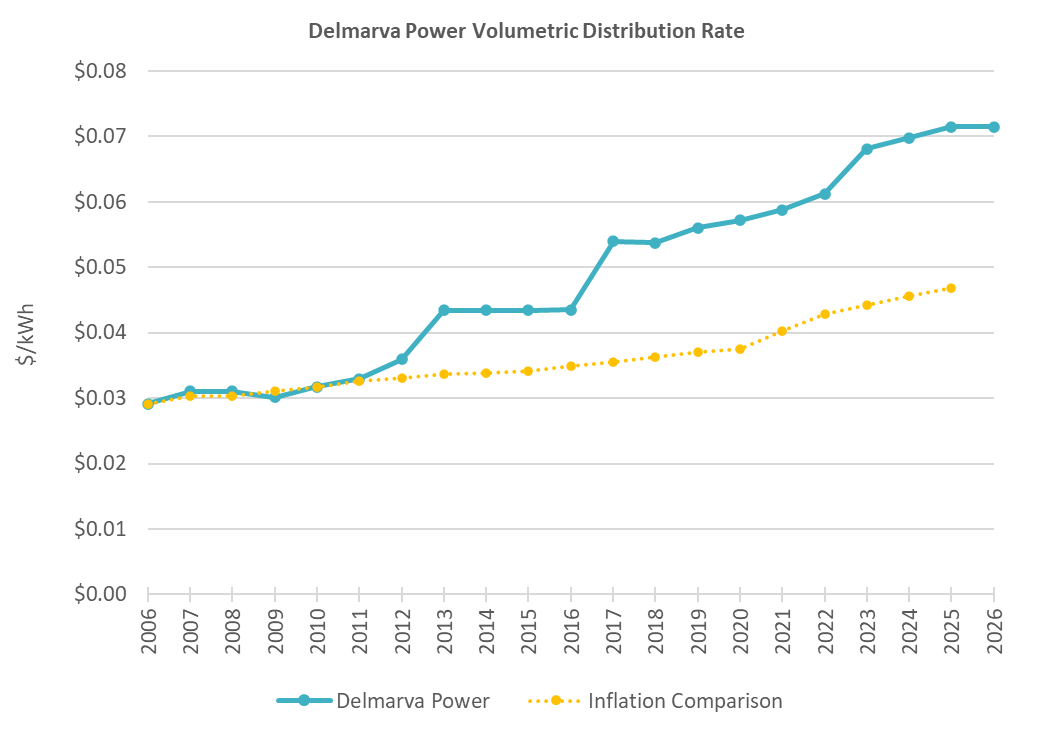
When combined with increased gas or electricity use (depending on your heating source) because of cold or hot temperatures, increased distribution rates will cause much larger bills than usual.
OPC’s June 2024 report, updated March 2025, Maryland’s Utility Rates and Charges, contains helpful charts and figures showing how rates have gone up for most—but not all—Maryland gas and electric utility customers. It explains some of the main categories of charges on your utility bill as well as reasons for the rate increases.
Generally, distribution charges have gone up in recent years because of a high rate of utility spending on new, long-lasting infrastructure, such as electric wires and poles, substations, meters, computers, trucks and other equipment. More spending increases utility profits as customers pay for the infrastructure through rate increases.
The other major components of your gas and electric bills, separate from distribution or “delivery” costs—are supply costs, which include different components for gas and electricity.
Delmarva’s supply cost for electricity in summer 2026–about 11.0 cents per kWh–is slightly higher than in summer 2025–about 10.5 cents per kWh. Electric supply costs include capacity and energy. The capacity portion of Delmarva Power’s electric supply rates have increased and will remain in place for the foreseeable future, largely due to the capacity market impacts of data centers and projected data center growth. Energy costs are also higher than years past, also impacted by data centers.
Transmission costs, while not technically part of the “supply costs,” are commingled with energy and capacity costs in the “supply” portion of customer bills. Transmission costs have been steadily rising and make up about the same portion of customer bills as capacity costs. Transmission lines are big power lines that generally carry large quantities of electricity over long distances.
For more information on rising transmission costs, read OPC’s report, PJM Transmission Cost Impacts on Electricity Customers in Maryland, published in March 2026.
For more information on the capacity markets, data centers, and transmission, visit our “FERC and PJM Issues” webpage.
What about the EmPOWER program costs on my bill?
EmPOWER is an energy-efficiency, greenhouse gas (GHG) reduction, energy conservation, and demand response program. (Demand response measures reduce energy demand during times of high usage.) EmPOWER is administered by the State’s largest utilities and funded by their customers through a surcharge on customer bills. The EmPOWER surcharge, or fee, is “volumetric,” which means that the more energy you use, the more you will contribute to the EmPOWER programs. If you use more energy during the summer months, you will pay more towards the EmPOWER surcharge.
With the additional costs of paying down the costly unpaid balance (described below) and other EmPOWER cost changes, effective January 2026, the EmPOWER rate for Delmarva Power electric customers has gone from $0.012649 per kWh to $0.020055 per kWh. For an average residential electric customer using 900 kWh per month, the change amounts to an increase of $6.67 per month, going from the 2025 charge of $11.38 per month to a new charge The Utility RELIEF Act, passed in the 2026 legislative session, reduces the GHG reduction goals in the EmPOWER statute and will lead to reduced program spending and slightly lower surcharge costs. The legislation also includes a one-time contribution to EmPOWER program costs of $100 million, which will also lower the surcharge. The reduced programs will beneficially lower costs in the short term, but reduced EmPOWER programming is likely to drive higher costs over the longer term.
EmPOWER programs can help you save money on your energy bills, and OPC encourages all utility customers to take advantage of available EmPOWER programs. Click here for more information on how to take advantage of these valuable efficiency programs.
All EmPOWER programs must be approved by the Maryland Public Service Commission. The Commission only approves the programs if it finds that they are cost-effective overall—meaning that the benefits they provide are greater than the costs.
Legislation enacted in 2024 requiring the elimination of a large unpaid balance for EmPOWER programs and services that developed over time following a 2008 Maryland Public Service Commission order. Since around 2008, aside from program costs and services, customers have had to pay the utilities’ “carrying charges,” akin to interest, for maintaining the unpaid balance. This unpaid balance was highly costly for customers—like carrying a credit card balance over decades without paying down the principal balance. Under the Commission order, the unpaid balance will be eliminated gradually over several years through an increase in the EmPOWER surcharge, ultimately saving customers tens of millions of dollars each year. In the 2024 legislation, the General Assembly significantly reduced the rate of return that utilities will be paid on the balance (akin to an interest rate) in future years, reducing the costs to customers of the unpaid balance while it is being paid down.
What can I do to keep my bill from increasing?
Most of your bill is calculated based on your usage. Using less electricity or gas over the month will lower your bill. You should consider reaching out to programs that can make your home more energy efficient (see immediately above). Free and low-cost programs are available to people at most income levels through the Maryland Department of Housing and Community Development. Visit the “Energy Bill Savings” section on our website to learn more.
If you want to start small on your energy efficiency journey, call your utility company and request a FREE home energy audit. When you call, the company will schedule a time for someone to come to your home and check for quick ways you can save money by reducing your usage. The company can suggest ways to make your home more energy efficient and may provide you with free energy saving products for your home.
Where can I get help?
If you are falling behind or struggling to pay your gas and/or electric bill, there is help available. Visit the “Get Help” section on our website for resources.
What has OPC been doing to push back costs?
OPC continues to push back on rising costs. You can read about some of our recent work below or check out our press releases for a full list.
OPC urges federal regulators to preserve competition for costly transmission projects (6/1/2026)
OPC complaint challenges PJM cost rules for unfairly assigning $2 billion in data center-driven transmission costs to Marylanders (5/7/2026)
Electric transmission costs have soared for Maryland customers and will grow much faster in coming years, new OPC report shows (3/19/2026)
Federal agency must fix mistake that cost Delmarva customers $180 million, OPC tells federal appeals court 11/18/2025
Multi-year rate plans harm customers with or without Exelon’s proposed tweaks, OPC tells regulators (9/9/2025)
Note: The distribution rates referenced above are Delmarva’s base rates which may vary from what you see on your bill because of additional adjustments, such as adjustments made for weather and changes in electricity usage.