Why is my winter Pepco bill so high?
If you’ve had sticker shock from your recent Pepco bills, you’re not alone. Most Pepco customers have seen substantial increases in their monthly bills in recent years—an experience that can be exacerbated by high energy usage amid cold temperatures.
Why are bills going up?
Your energy bill is going up in part because the costs Pepco charges to deliver electricity to your home have been rising significantly in recent years. Very cold or hot temperatures also drive up your bill because you use more energy to heat or cool your home.
Since 2020, Pepco’s delivery charges—to pay for the distribution system, not the electricity itself—have increased 33 percent from 4.6 cents per kWh to 6.2 cents per kWh overall. A kilowatt hour (kWh) is the unit used to measure how much electricity you use in your home. Because Pepco’s summer rates apply for five months of the year and its winter rates apply for seven months, the overall rate reflects a weighted average of those two seasonal rates.
Pepco also recently requested a further distribution rate increase of 23 percent—an increase of 15 percent to summer rates and 33 percent to winter rates, which would push rates to 7.6 cents per kwh overall.
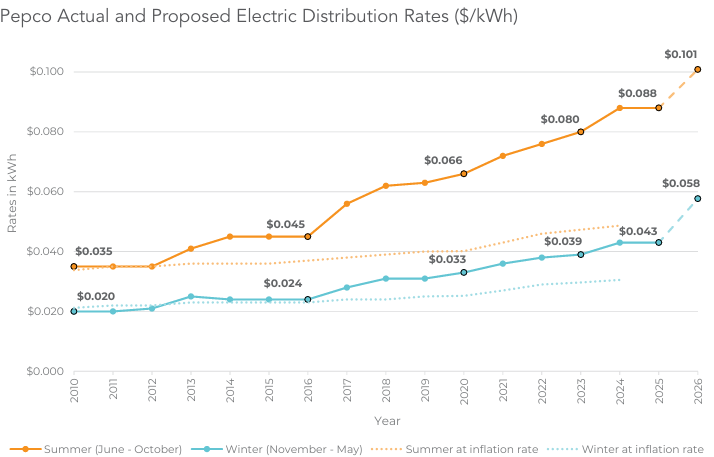
When combined with increased electricity use because of especially cold or hot temperatures, increased distribution rates will cause customers to experience much larger bills than usual.
The graph above is taken from OPC’s Consumer Guide to Pepco’s Proposed Rate Increase, released in December 2025. OPC is evaluating Pepco’s proposal and will advocate in the rate proceeding to keep residential rates as low as possible while maintaining safe and reliable service. The Consumer Guide provides information on how customers can stay informed and give input into Pepco’s proposal.
OPC’s June 2024 report, updated in March 2025, Maryland’s Utility Rates and Charges has additional helpful charts and figures showing how rates have gone up for most—but not all—Maryland gas and electric utility customers. It explains some of the main categories of charges on your utility bill as well as reasons for the rate increases.
Generally, distribution charges have gone up in recent years because of a high rate of utility spending on new, long-lasting infrastructure, such as electric wires and poles, substations, meters, computers, trucks and other equipment. More spending increases utility profits as customers pay for the infrastructure through rate increases.
Supply costs are the other major component of your electric bill, separate from distribution costs. Electric supply costs include costs for electricity generation and “bulk” transmission. Bulk transmission lines are big power lines that generally carry large quantities of electricity over long distances. Generation means the output of power plants, such as fossil-fuel power plants or renewable energy such as wind and solar. Supply costs go up and down from year to year. Pepco’s supply cost for electricity in winter 2026 is slightly higher than in winter 2025, at about 13.6 cents per kWh in winter 2026 vs 12.2 cents per kWh in winter 2025.
Supply costs are going up in part because transmission costs have been steadily increasing and because of recent increases in “capacity market” prices, attributable largely to actual and expected power demands resulting from data centers. For more on the capacity market increases, visit our “FERC and PJM Issues” webpage.
What about the EmPOWER program costs on my bill?
Pepco customers are also seeing higher costs in their bills for the company’s EmPOWER program. The EmPOWER surcharge funds programs that can help you reduce your energy consumption, reduce greenhouse gas emissions, and save money. EmPOWER programs must be approved by the Maryland Public Service Commission. The Commission only approves the programs if it finds that they are cost-effective overall—meaning that the benefits they provide are greater than the costs.
The bill increases relate, in part, to legislation enacted in 2024 requiring the elimination of a large unpaid balance for EmPOWER programs and services. The balance built up over time following a 2008 Maryland Public Service Commission order that allowed Pepco to charge customers only a portion of EmPOWER costs in the year they were incurred, while earning carrying charges on the amount that was not paid. This arrangement was very costly for customers—like carrying a credit card balance over decades without paying down the principal balance. Under a 2022 Commission order, the unpaid balance will be eliminated over several years through an increase in the EmPOWER surcharge, ultimately saving customers tens of millions of dollars each year. In the 2024 legislation, the General Assembly significantly reduced the rate of return that utilities are being paid on the balance (akin to an interest rate) in future years, reducing the customer costs of paying down the unpaid balance.
In January 2026, the EmPOWER rate for Pepco customers rose from $0.013790 per kWh to $0.020618 per kWh to pay for the additional costs of eliminating the unpaid balance and other EmPOWER cost changes. For a residential electric customer using 900 kWh per month, the change amounts to an increase of $6.15 per month, or a total EmPOWER charge of $18.56 per month.
More information on these programs and how to participate is available here.
What can I do to keep my bill from increasing?
Most of your bill is calculated based on your usage. Using less electricity over the month will lower your bill. You should consider reaching out to programs, including Pepco’s EmPOWER program, that can make your home more energy efficient. For lower-income households, free and low-cost programs are available to people through the Maryland Department of Housing and Community Development. Visit the “Energy Bill Savings” section on our website to learn more.
If you want to start small on your energy efficiency journey, call Pepco and request a FREE home energy audit. When you call, the company will schedule a time for someone to come to your home and check for quick ways you can save money by reducing your usage. The company can suggest ways to make your home more energy efficient and may provide you with free energy saving products for your home.
Where can I get help?
If you are falling behind or struggling to pay your gas and/or electric bill, there is help available. Visit the “Get Help” section on our website for resources.
What has OPC been doing to push back costs?
OPC continues to push back on rising costs. You can read about some of our recent work below or check out our press releases for a full list.
Pepco proposes 23 percent distribution rate hike—on top of massive rate increases over last decade, OPC Consumer Guide shows (12/11/2025)
OPC asks PJM Board to intervene to protect customers from billions in costs from new forecasts of massive data center growth (10/15/2025)
Multi-year rate plans harm customers with or without Exelon’s proposed tweaks, OPC tells regulators (9/9/2025)
Regulators should reject Exelon utilities’ accounting maneuver that would deny customer refunds, OPC filing says (5/29/2025)
State regulators should deny Pepco’s proposed $30.6 million additional rate hike, OPC filing says (4/9/2025)
Note: The distribution rates referenced above are Pepco’s base rates which may vary from what you see on your bill because of additional adjustments, such as adjustments made for weather and changes in electricity usage.